
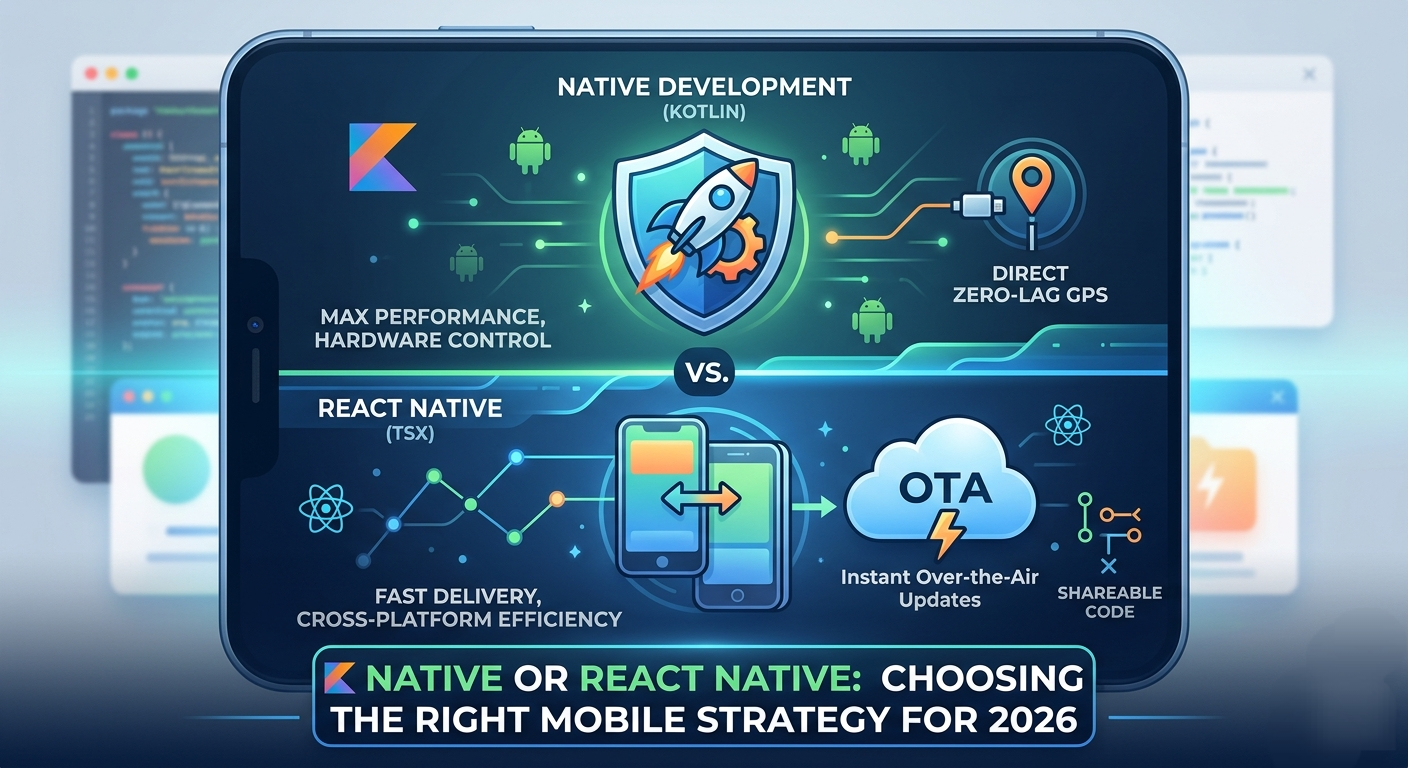

When launching a new project, choosing the right mobile app strategy is the most critical technical decision you will make. Whether you opt for the high-performance route of Native Kotlin or the rapid iteration of React Native, your choice will define your development speed and long-term maintenance costs in 2026.
Defining Your Mobile App Strategy: React Native vs. Kotlin
As we navigate 2026, the gap between these two has narrowed, but the philosophical differences in how they handle hardware and updates remain as distinct as ever. If you are a developer or a tech lead deciding on a stack for your next project, here is the deep dive you need.
1. Why OTA Updates are Central to a Modern Mobile App Strategy
For many developers, the “killer feature” of React Native isn’t actually the cross-platform code sharing—it’s Over-the-Air (OTA) updates.
In a traditional Native workflow, a critical production bug requires a full rebuild, a submission to the Google Play Store, and a nervous 24-hour wait for approval. With React Native, your business logic lives in a JavaScript bundle. Using tools like Expo Updates, you can push a fix directly to your users’ devices in seconds.
Key Takeaway: If your product requires frequent UI iterations or handles high-stakes logic (like a logistics or taxi-aggregator platform), the ability to bypass the store review process is a massive competitive advantage.
2. The Native Edge: Precision and Background Longevity
While React Native wins on deployment speed, Native Kotlin remains the undisputed king of “the metal.”
Native development gives you zero-latency access to the Camera2 API, high-speed Bluetooth Low Energy (BLE) stacks, and complex sensor data. More importantly, Native offers superior control over Background Services.
Android’s battery optimization is aggressive. Native developers can use the WorkManager API to ensure that tasks—like uploading large logs or syncing GPS data for a delivery driver—don’t get killed when the user minimizes the app. React Native often struggles with “Headless Tasks” that can be inconsistent across different device manufacturers.
3. The New Architecture: JSI and the Death of the “Bridge”
One of the biggest myths in 2026 is that “React Native is slow because of the bridge.”
Modern React Native has moved to the New Architecture, replacing the old asynchronous JSON bridge with JSI (JavaScript Interface). This allows the JavaScript engine (Hermes) to hold a reference to C++ host objects and invoke methods on them synchronously.
- Fabric: The new UI renderer that makes complex animations feel native-smooth.
- TurboModules: Lazy-loading for native modules, which significantly reduces app start time.
4. The Developer Experience (DX) and Costs
From a business perspective, the math is often simple.
- React Native: You hire one team of TypeScript/React developers to manage 90% of the code for both Android and iOS. Your “Time to Market” is halved.
- Native: You typically need two separate teams (Kotlin for Android, Swift for iOS). This is more expensive but results in an app that is 15-20% more battery-efficient and has a smaller binary size (roughly 5MB vs. 20MB for a base app).
5. The Decision Matrix: Which One Should You Build?
| Project Requirement | Recommended Stack | Why? |
|---|---|---|
| MVP / Quick Launch | React Native | Rapid iteration and code reuse. |
| High-End 3D / AR / VR | Native (Kotlin) | Direct GPU access and thread management. |
| Complex Background Sync | Native (Kotlin) | Reliable Foreground Services and WorkManager. |
| E-commerce / Social Media | React Native | Frequent UI changes and OTA bug fixes. |
Final Thoughts
The “right” choice depends on your project’s soul. If you are building a utility that needs to be an invisible, highly efficient part of the OS, go Native. If you are building a service-based platform that needs to move fast and fix bugs in real-time, React Native is your best friend.
As a developer who has worked across the stack—from Laravel backends to mobile frontends—I’ve found that the best apps often use a Hybrid approach: 90% React Native for the UI, with specific high-performance modules written in pure Kotlin.